How does your nursing facility’s financial health stack up against industry peers? Benchmarking can provide you with clear, relevant comparisons that are essential to measuring and optimizing your facility’s performance. Cost data and key operating indicators from the Maine Medicaid cost reporting database provide an in-depth look at key trends for both nursing facilities and nursing facility-based residential care facilities (RCF).
Occupancy
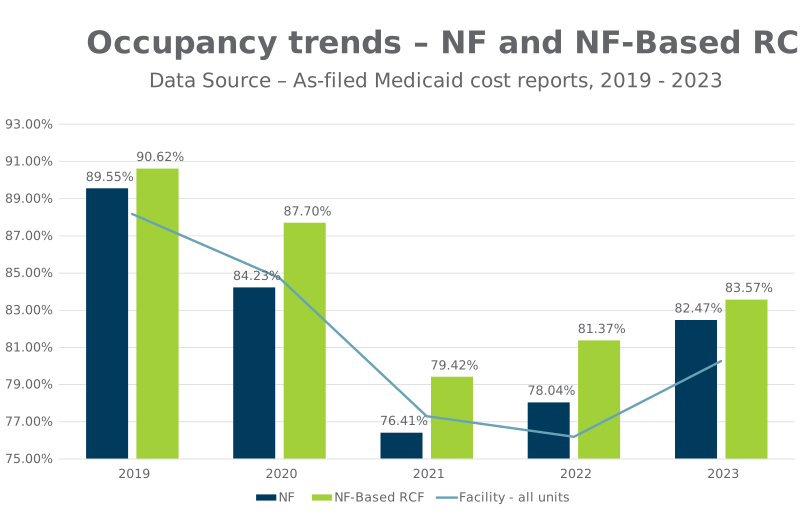
For both nursing facilities and nursing facility-based RCFs, occupancy was about 90% in 2019 and through early 2020 (pre-COVID-19). Once the pandemic hit, occupancy began to decline, then dropped significantly in 2021 at the height of the crisis. By 2022, occupancy trends started to rebound, bringing nursing facilities up to nearly 82% occupancy and nursing facility-based RCFs up to about 84%. The regional average in 2023 was about 81% occupancy versus a national average of 76%. This trend continued through 2024.
Medicaid reimbursement
Data for 2012 – 2023, when nursing labor and occupancy significantly drove per resident day costs up, demonstrates a Medicaid shortfall for Maine nursing facilities. In 2023, the Medicaid shortfall reached $35 million, but would have nearly doubled to $65 million without supplemental payments released by Maine DHHS to help curb the impact of exponentially rising costs.
MaineCare revenue and cost
From 2014 – 2022, MaineCare experienced a steady rise in cost per patient day (PPD). In 2023, the allowable cost PPD hit $370 — $213 of which was direct care cost, and of that $84 was related to contract nursing. Revenue PPD was just $330. These costs are after supplemental payments and any ECA (Extraordinary Circumstances Allowance) funds were applied. The broadening gap between reimbursement rates and cost for nursing facilities is clear.
Payer mix
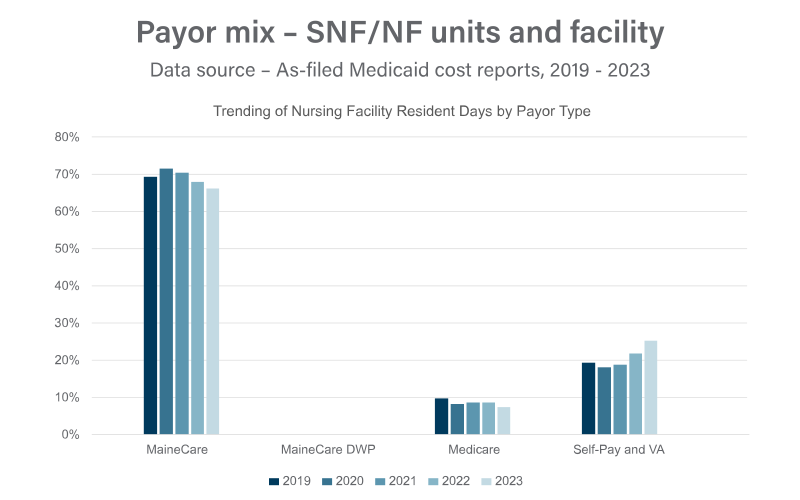
From 2019 – 2023, there was a significant shift in the payer mix for nursing facilities, with an increase in the use of Medicare Advantage and a decrease in Medicaid and Medicare A payers. This is indicative of the growing diversity in payer sources and underscores the importance of facilities understanding and adapting to the intricacies of Medicare Advantage plans, which include pre- and post-payment reviews.
Nationally, Medicare Advantage has grown from 27% utilization by Medicare beneficiaries in 2012 to 54% in 2024, and Maine is one of seven states with more than 60% of eligible Medicare beneficiaries enrolled in the Medicare Advantage plan.
Labor trends
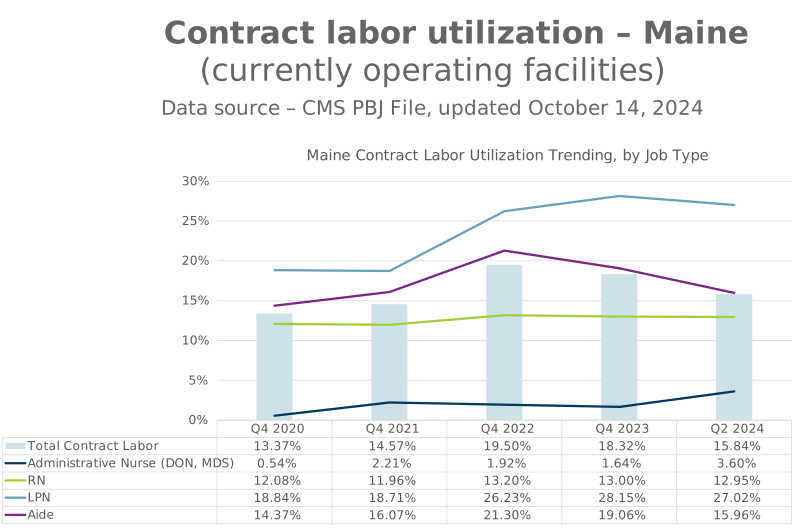
The use of contract labor has been a significant source of frustration for nursing facilities, especially in Maine. Payroll-Based Journal (PBJ) reporting for Maine for Q2 2024 reflects an alarming increase in the use of administrative nurses, such as nursing directors and MDS coordinators, and highlights the need to improve retention for leadership positions. Q4 2020 through Q4 2024 showed an increase in contract labor utilization for LPNs — a cost-saving measure for providing licensed nursing care.
.svg)
Data from Q4 2023 to Q2 2024 on the use of contract staff in Maine by county points to labor challenges in rural counties, while it shows facilities in more urban counties are better able to maintain staffing requirements with in-house staff. Some counties relied so heavily on contract labor that it accounted for approximately 45% of all staffed hours.
The cost of contract labor for Maine facilities skyrocketed from its 2020 cost PPD of $25 — nearly tripling to $70 in 2023. The driving factor behind this was the increased demand for contract labor services. PBJ data for 2022 – 2024 shows a more positive trend for staff turnover despite continued challenges with contract labor. Registered nurse turnover decreased by 10% and overall staff turnover levelled off.
Other trends
The number of nursing facilities by fiscal year remained stable for 2020 and 2021 but began to decline steadily from 2022 – 2024. This trend can be attributed to the deepening gap between costs — both for direct care and contract labor — and reimbursement, forcing some facilities to close or convert to residential care facilities. In 2023, there were approximately 86 nursing facilities with a total of roughly 7,696 beds in Maine.
2025 rate reform is designed to address the financial challenges of nursing facilities.
- The transition to the pricing methodology has eliminated the cost settlement for direct and routine costs, enabling facilities to plan expenses and manage costs on known rates for the year.
- Rate reform also includes value-based purchasing adjustments, which allow facilities to earn back a portion of their rate reduction through quality improvements or achievements.
- The guiderails allow for potential rate adjustments of up to a 10% increase or decrease compared to prior rates, creating flexibility in the management of reimbursement rates.
For nursing facilities seeking to improve financial operations, BerryDunn’s industry experts can assist with benchmarking by analyzing data on occupancy, Medicaid reimbursement, and contract labor to guide you to better understand how your cost and revenue drivers can lead to outcomes. Learn how to access our self-service Senior Living Benchmarking Portal for a carefully curated, comprehensive set of financial benchmarking reports. To learn more, visit berrydunn.com/stay-current.