Read this if you use, manage, or procure public safety and corrections technology.
In our previous post, we discussed the link between developing a technology RFP with meaning, structure, and clarity to enhance the competitive nature of the solicitation. In this article, we ask: How can your agency synthesize and unify existing business processes with industry standards to attract modern OMS providers? The answer? Your agency crosswalks.
Industry standards, such as those set by the Corrections Technology Association (CTA) and American Probation and Parole Association (APPA), establish the benchmark for modern operations. However, legacy correction software limitations often blur the one-to-one relationship with industry standards. For that reason, crosswalk tools help agencies map current process into industry-wide standards.
CTA Functional Areas
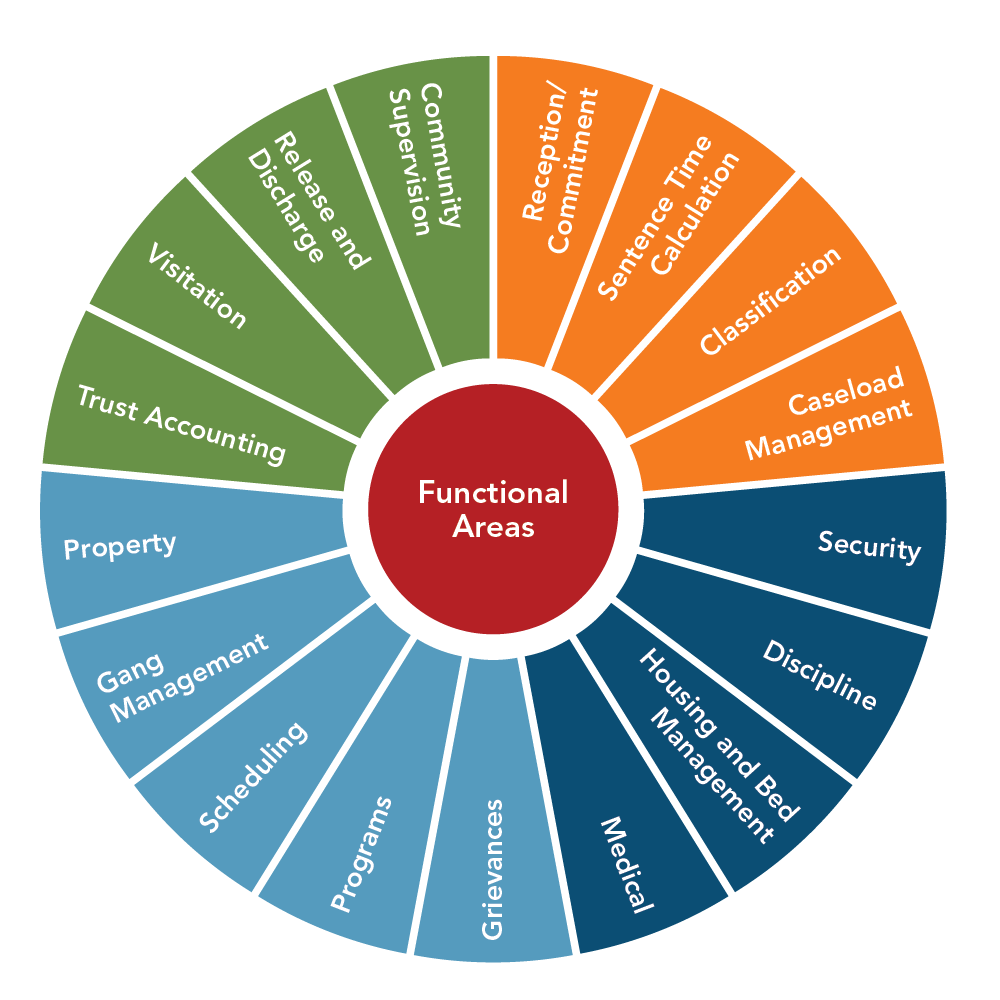
Agencies crosswalk in preparation for a corrections technology procurement to help align system requirements with commercial-off-the-shelf (COTS) corrections management systems. In revisiting the topics of clarity, meaning, and structure, the crosswalk helps technology vendors understand your current operations, the tools your currently use to support the operations, and the way in which those operations relate to industry functional areas.
In an iterative fashion, the CTA crosswalk first helps you understand your agency’s technology and operational structure, and then communicates system requirements to correction technology providers in an industry-led framework. The approach helps you transition from your legacy processes to your new operational environment.
Although your agency can engage the market with a meaningful, structured, and clear RFP, prequalification and contract vehicles provide a viable alternative of enhancement to procuring a new offender management system. The following advantages and disadvantages can inform your agency’s decision to use a prequalification vehicle.
Advantages:
- Non-competitive procurement can often be accomplished more quickly given the absence of the timeframe usually dedicated to the development of the RFP, posting to potential vendors, and evaluation of proposals.
- Reduced uncertainties in terms of what a vendor is able to provide since an open dialog starts immediately.
- Competitive procurement (secondary competition) under a contract vehicle is limited to the vendors who proposed and were awarded. Only higher performing vendors are likely to be able to respond, particularly if only certain vendors are selected from the list.
- Potentially better pricing as a vendor can eliminate unknowns through open communication, so less risk is priced into the proposal.
- A better environment around requested changes, as a vendor that has maintained a certain margin in their pricing may be more amenable to no-cost change orders.
Disadvantages:
- The agency loses some negotiating advantage when a vendor knows they are the only ones in the procurement conversation.
- A vendor may have less incentive to “put their best foot forward” and offer higher levels of service and functionality.
- Competitive cost may not be obtained because the vendor doesn’t have to worry about beating a competitor.
- Secondary competition may take a somewhat similar timeframe because the solicitation, evaluation, and award processes take a similar amount of time to an RFP for larger projects.
The trajectory to develop an RFP for new corrections management software spans assessing existing operations and technology to including mapping current operations into industry standards clarity. At the same time your agency should consider the driving and constraining factors for using a prequalification or contract vehicle.
BerryDunn has experience with cross-walking agencies into industry-leading practices, and we also understand the need for non-standard RFPs that extend beyond CTA and APPA guidelines. Reach out to our public safety consultants if you have questions, or look out for our next blog providing insight on adapting to and overlapping challenges in non-standard corrections technology procurements.