Skip to Main Content

insightsarticles

Impacts of ABAWD policy changes on unsheltered homelessness: Statewide responses

By:

Skye is a consultant in BerryDunn's State Government Practice Group where she supports client engagements through analytical, operational, and advisory work. Skye collaborates with project teams to help organizations navigate complex challenges and improve performance.

Skye Kwong
03.30.26

According to the US Department of Housing and Urban Development’s (HUD’s) 2024 Annual Homelessness Assessment Report, nearly 770,000 people experienced homelessness on a single night in January 2024, an 18% increase from the prior year and the highest total since point-in-time counts began in 2007. Family homelessness surged by almost 40%, and unsheltered homelessness grew in parallel, with more than one-third of all unhoused individuals living in tents, vehicles, encampments, or other places not meant for human habitation. Chronic homelessness also reached a record high, with over 152,000 people experiencing long-term or repeated episodes of homelessness; nearly two-thirds were unsheltered.

The Supplemental Nutrition Assistance Program (SNAP) is one of the most effective stabilizers for extremely low-income households, reducing food insecurity by up to 30% and lowering downstream healthcare costs, according to research from the University of Pennsylvania Leonard Davis Institute of Health Economics and Harvard Public Health scholars. For people experiencing homelessness, particularly those who are unsheltered, SNAP access often determines whether limited resources can be redirected toward transportation, medical care, or pathways into housing.

The H.R. 1 One Big Beautiful Bill Act (OBBBA) marks a critical turning point. By expanding Able Bodied Adults Without Dependents (ABAWD) requirements and tightening SNAP and Medicaid eligibility, the bill reshapes access to public assistance programs that help prevent people from falling deeper into homelessness. New compliance hurdles threaten food security for many unsheltered individuals who cannot realistically meet the documentation and work requirements. The OBBBA ABAWD expansion points to the need for a new statewide approach to unsheltered homelessness that better supports the safety and health of unsheltered families.  

Why unsheltered adults are most at risk under ABAWD rules 

Under OBBBA, SNAP eligibility and participation rules are significantly tightened through an expansion of ABAWD requirements. The law extends SNAP time limits to all adults ages 18-64 and eliminates the longstanding exemption for people experiencing homelessness. Individuals subject to ABAWD rules must now document at least 80 hours per month of work, job training, or qualifying volunteer activities to maintain benefits. OBBBA also narrows overall SNAP eligibility, resulting in benefit losses for additional groups, including certain immigrants, such as asylees and parolees, individuals with deportation withheld, and individuals exiting the foster care system.

These changes have particular implications for people experiencing homelessness, for whom meeting work and reporting requirements is often far more difficult. Unhoused individuals frequently lack a permanent address, reliable transportation, or consistent access to phones, internet, or mail. Lost identification documents, irregular schedules, and high rates of chronic physical and behavioral health conditions further limit their ability to document hours or navigate verification systems. Older unhoused adults, now newly subject to ABAWD rules, often face compounded barriers due to health conditions or unstable work histories. 

At the same time, OBBBA increases administrative and reporting demands across SNAP. For individuals without stable housing, these added requirements raise the risk of procedural disenrollment even when eligibility criteria are technically met. As SNAP access declines, food insecurity among people experiencing homelessness is expected to increase, shifting greater demand onto food pantries, shelters, and other emergency food providers. Estimates from the Urban Institute suggest that nearly 700,000 young adults could lose some or all SNAP benefits each month under expanded work‑reporting rules, underscoring the scale of potential impact.

SNAP ABAWD requirements: Before and after OBBBA 
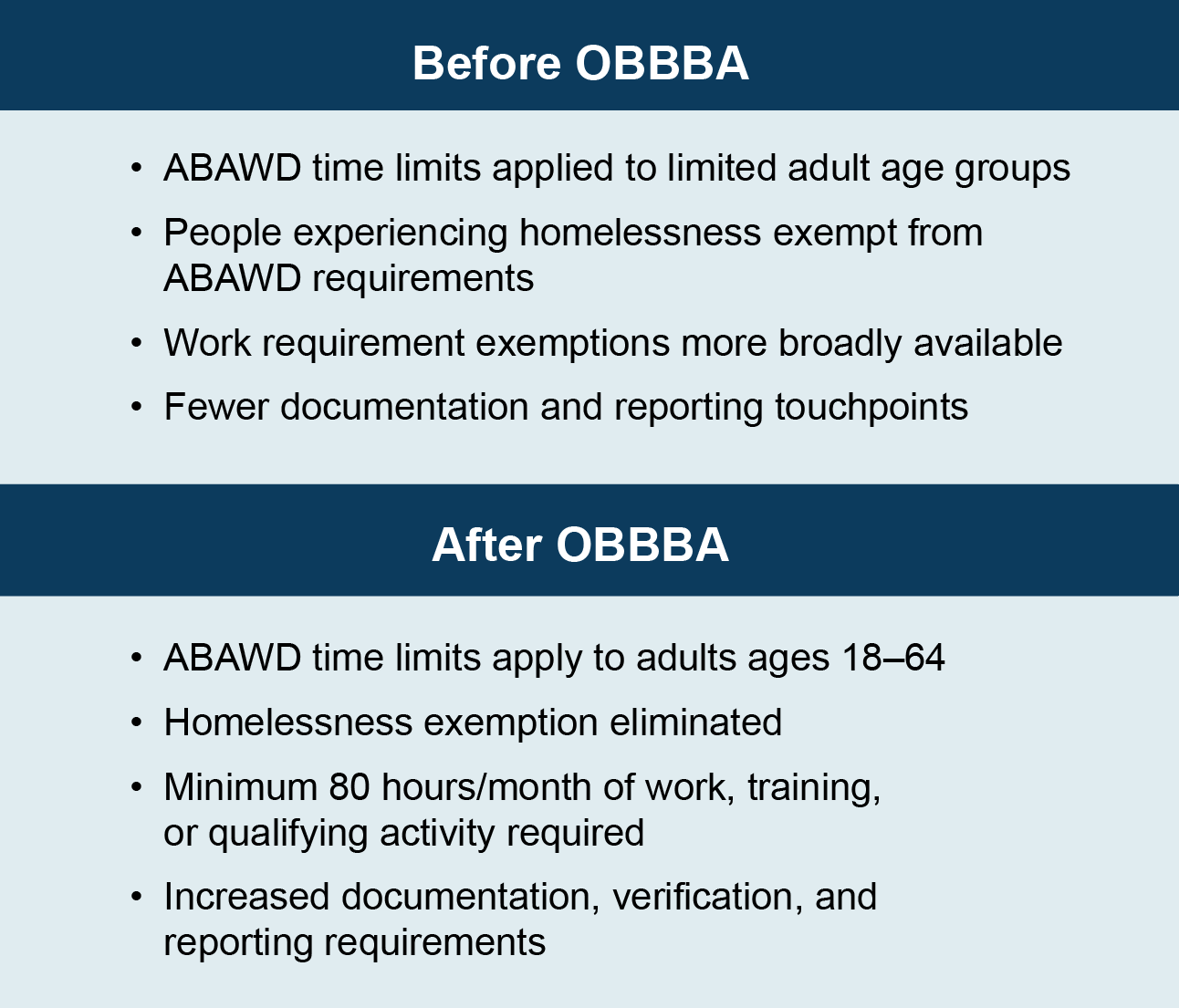
OBBBA significantly expands SNAP ABAWD requirements, removing the longstanding homelessness exemption and increasing documentation and work reporting expectations. 

What states can expect 

States must now implement expanded ABAWD rules under far tighter federal expectations. OBBBA increases state administrative cost‑sharing for SNAP and adds new sanctions, reporting mandates, and verification requirements, creating significant fiscal and operational strain for human services agencies already managing complex caseloads. 

OBBBA’s SNAP changes result in: 

  • Increased administrative costs and cost-sharing 
  • Need to modify systems and technologies 
  • Close workforce and provider capacity gaps, such as workforce training slots, subsidized employment programs 
  • Documentation bottlenecks and backlog due to increased reporting and verification requirements 
  • Concerns over equity impact, including older adults, individuals with disabilities, and vulnerable populations 
  • Increased pressure on emergency services 
  • Additional pressure on community partners and systems as more people lose benefits 

Collectively, states face greater fiscal pressure: increased responsibility for SNAP administration and rising demand from individuals who have become newly food‑insecure. 

What can states do? 

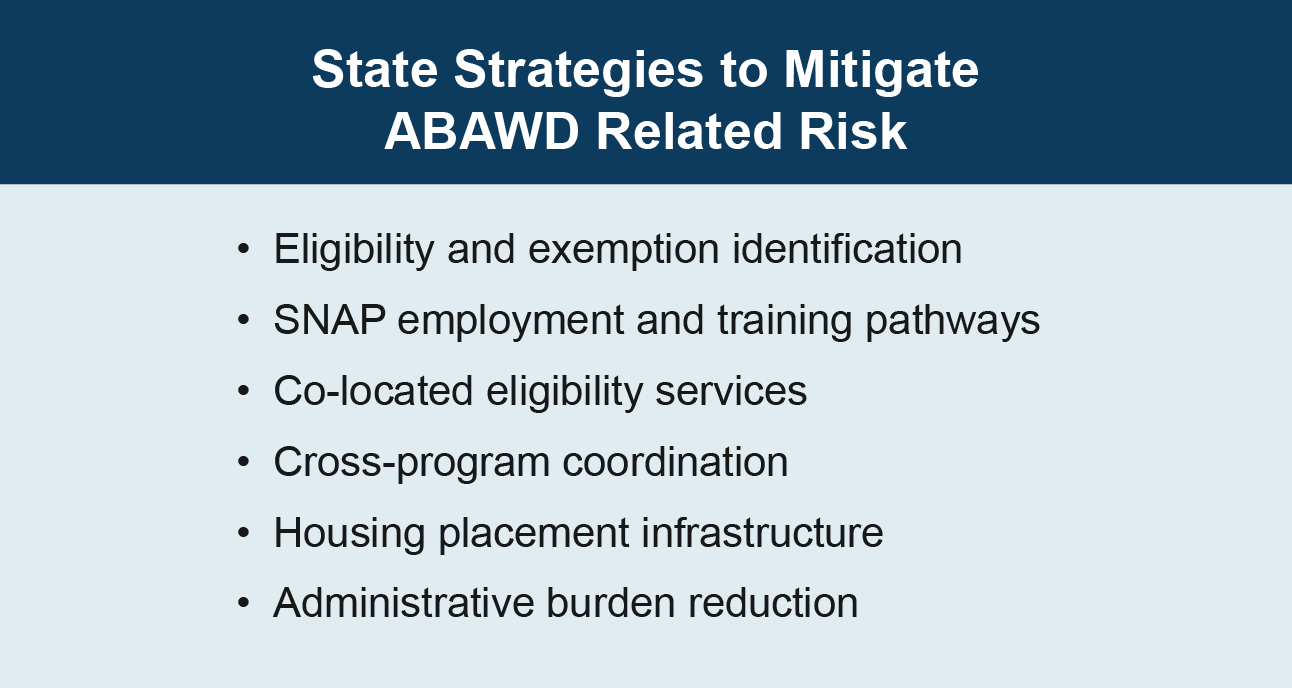
States can consider the following strategies across eligibility, workforce, and employment programs to mitigate these risks. 

  1. Strengthen ABAWD Screening and Exemption Identification 

With the elimination of the homelessness exemption, states must ensure all remaining exemptions are identified early and accurately, particularly physical or mental unfitness for work, which is highly prevalent among unsheltered adults. States can: 

  • Partner with community health centers and behavioral health providers to rapidly document qualifying impairments

  • Train eligibility workers, outreach teams, shelter staff, and case managers to flag individuals likely to qualify for exemptions

  1. Build Direct Pathways into SNAP Employment & Training (E&T) 

For individuals unable to secure consistent work hours, E&T will become a primary compliance pathway. States can: 

  • Co-design low-barrier, trauma-informed E&T tracks with homelessness providers

  • Ensure programs are flexible, accessible, and supported by transportation or virtual options

  1. Co-locate Eligibility Services in Homelessness Settings 

Preventing procedural terminations will require bringing eligibility services directly to people experiencing homelessness. States can: 

  • Deploy mobile eligibility teams to shelters, encampments, day centers, meal sites, and transitional housing
  • Embed SNAP, Medicaid, and workforce eligibility staff in high-volume service providers, including behavioral health clinics and social service providers
  • Establish rapid recertification stations to assist with reporting, documentation, and renewals
  • Partner with libraries and community centers to provide digital access, printing, and identity verification support
  1. Coordinate SNAP, Medicaid, and housing systems 

Because OBBBA also imposes Medicaid cuts and work requirements, cross-program coordination is essential to maintain stability. States can: 

  • Integrate data systems to trigger alerts when individuals lose benefits or fall out of compliance

  • Create unified outreach teams spanning SNAP, Medicaid, and housing services

  1. Strengthen housing placement infrastructure 

Loss of nutrition and health benefits increases the risk of prolonged homelessness, making housing exits more urgent. States can: 

  • Expand supportive housing for chronically homeless adults newly subject to ABAWD requirements. 

  • Increase landlord engagement and mitigation funds to shorten placement timelines. 

  • Integrate housing navigation into SNAP and Medicaid case management. 

  1. Reduce administrative burden 

Expanded ABAWD rules significantly increase administrative demands. To reduce churn and unnecessary benefit loss, states can: 

  • Automate work hour reporting and simplify notices
  • Implement presumptive eligibility for high-risk populations while documentation is gathered. 
  • Expedite renewals and recertifications for individuals facing termination due to administrative barriers. 

State strategies to mitigate ABAWD-related risk 

States can mitigate the impact of expanded ABAWD requirements through coordinated eligibility, workforce, housing, and administrative strategies. 

OBBBA’s expanded ABAWD time limits and massive cuts to SNAP arrive at a moment of rising unsheltered homelessness, shrinking safety nets, and deepening public health risks. The combination threatens to push thousands of adults into homelessness while overwhelming state systems. By recognizing the convergence of ABAWD rules and unsheltered homelessness and responding proactively, states can prevent avoidable harm, reduce long-term costs, and stabilize residents on the brink. 
BerryDunn can help

Our human services consulting team works with you to help build sustainable programs that support the safety and well-being of children, youth, and families, while supporting the professionals who serve them. We work with agencies to leverage information and drive data-based decision-making for interested parties to create more stable environments that support the reduction in vulnerability among children, youth, and families. Learn more about our team and services. 

Related Professionals

Leaders

We’ve all heard stories about organizations spending thousands on software projects, such as Enterprise Resource Planning (ERP), Electronic Health Record (EHR), or Student Information Systems (SIS) that take longer than expected to implement and exceed original budgets. One of the reasons this occurs is that organizations often don’t realize that purchasing a large, Commercial Off-The-Shelf (COTS) enterprise system is a significant undertaking. If the needs aren’t sufficiently defined, there can be many roadblocks, including implementation delays, increased cost, scope creep, and ultimately, unsatisfactory results (delayed or unfinished projects and cost overruns).

These systems are complex, and implementation efforts impact both internal and external stakeholders. Procurement often requires participation from different departments, each with unique goals and perspectives. Ignore these perspectives at your own peril. Here are key questions to consider for making the best buying decision:

  1. Should we purchase software that similar organizations have purchased?
    As vendor consolidation has diminished the number of distinct COTS systems available, this question is increasingly common. Following this approach is similar to deciding to buy the car that your neighbor did, because they seem satisfied. How can you be sure that the systems purchased by similar organizations will meet your needs, particularly if your needs are undefined? One way to identify your organization’s needs—and to avoid costly mistakes down the road—is to identify requirements during the procurement process.

  2. What are the functional and technical requirements of the system?Requirements are details that help describe a software system. There are two types of requirements and you need to understand and review both:

    Functional requirements. These define specific functions of a system to meet day-to-day needs of an organization or department. They describe the necessary system capabilities that allow users to perform their jobs. For example, “The vendor file must provide a minimum of four (4) remit-to addresses.” Functional requirements may also define the mandated state or federal capabilities required of a system, such as the ability to produce W-2 or 1099 forms.

    Technical requirements. These requirements identify criteria used to judge the operation of a system, rather than specific behaviors. They can be requirements that define what database the system must support. For example, “The system must support use of the client preferred database.” They may also describe security capabilities of the system, the ability to import or export data, or the ease of use and overall end-user interface.

  3. Who should help define and document requirements for the new enterprise system?

    When it comes to documenting and revising requirements, work with your IT staff; incorporating technology standards into a set of requirements is a best practice. Yet it is also necessary to seek input from non-IT individuals, or business process owners from multiple departments, those who will use and/or be affected by the new software system.

    Help these individuals or groups understand the capabilities of modern software systems by having them visit the sites of other organizations, or attend software industry conferences. You should also have them document the current system’s deficiencies. As for those in your organization who want to keep the current system, encourage their buy-in by asking them to highlight the system’s most valuable capabilities. Perspectives from both new system supporters and those not so eager to change will help build the best system.
     
  4. When do you revise enterprise system requirements?
    It is always important to begin the software procurement process with a documented set of requirements; you need them to identify the best solution. The same goes for the implementation process where vendors use the requirements to guide the setup and configuration of the new system. But be prepared to revise and enhance requirements when a vendor solution offers an improved capability or a better method to achieve the results. The best way to approach it is to plan to revise requirements constantly. This enables the software to better meet current needs, and often delivers enhanced capabilities.

Be sure to document system requirements for an efficient process

There may be thousands of requirements for an enterprise system. To make the procurement process as efficient as possible, continually define and refine requirements. While this takes time and resources, there are clear benefits:

  • Having requirements defined in an RFP helps vendors match the capabilities of their software systems to your organization’s needs and functional expectations. Without requirements, the software procurement and selection process has little framework, and from a vendor perspective becomes a subjective process — making it hard to get consistent information from all vendors.
  • Requirements help determine specific tasks and activities to address during the implementation process. While applications can’t always meet 100% of the requested functionalities, it’s important to emphasize the requirements that are most important to users, to help find the system that best meets the needs of your organization.
  • Requirements prove valuable even after implementation has begun, as they can help you test your system to make sure the software meets your organization’s particular needs before production use of the new system.

Our experienced consultants have led many software procurement projects and have firsthand knowledge about the challenges and opportunities associated with purchasing and implementing systems large and small. BerryDunn maintains an active database of requirements that we continually enhance, based on work performed for various clients and on technological advancements in the marketplace. Please contact us and we can help you define your requirements for large software system purchases.

Article
Four questions to ask before purchasing an enterprise software system

There’s a good chance that your organization is in the position of needing to do more with less under the strain of staffing constraints and competing initiatives. With fewer resources to work with, you’ll need to be persuasive to get the green light on new enterprise technology initiatives. To do that, you need to present decision makers with well-thought-out and targeted business cases that show your initiative will have impact and will be successful. Yet developing such a business case is no walk in the park. Perhaps because our firm has its roots in New England, we sometimes compare this process to leading a hiking trip into the woods—into the wild. 

Just as in hiking, success in developing a business case for a new initiative boils down to planning, preparation, and applying a few key concepts we’ve learned from our travels. 

Consensus is critical when planning new technology initiatives

Before you can start the hike, everyone has to agree on some fundamentals: 

Who's going? 

Where are we going? 

When do we go and for how long? 

Getting everyone to agree requires clear communication and, yes, even a little salesmanship: “Trust me. The bears aren’t bad this time of year.” The same principle applies in proposing new technology initiatives; making sure everyone has bought into the basic framework of the initiative is critical to success.

Although many hiking trips involve groups of people similar in age, ability, and whereabouts, for your business initiative you need to communicate with diverse groups of colleagues at every level of the organization. Gaining consensus among people who bring a wide variety of skills and perspectives to the project can be complex.

To gain consensus, consider the intended audiences of your message and target the content to what will work for them. It should provide enough information for executive-level stakeholders to quickly understand the initiative and the path forward. It should give people responsible for implementation or who will provide specific skills substantive information to implement the plan. And remember: one of the most common reasons projects struggle to meet their stated objectives (and why some projects never materialize to begin with), is a lack of sponsorship and buy-in. The goal of a business case is to gain buy-in before project initiation, so your sponsors will actively support the project during implementation. 

Set clear goals for your enterprise technology project 

It’s refreshing to take the first steps, to feel that initial sense of freedom as you set off down the trail. Yet few people truly enjoy wandering around aimlessly in the wilderness for an extended period of time. Hikers need goals, like reaching a mountain peak or seeing famous landmarks, or hiking a predetermined number of miles per day. And having a trail guide is key in meeting those goals. 

For a new initiative, clearly define goals and objectives, as well as pain points your organization wishes to address. This is critical to ensuring that the project’s sponsors and implementation team are all on the same page. Identifying specific benefits of completing your initiative can help people keep their “eyes on the prize” when the project feels like an uphill climb.

Timelines provide additional detail and direction—and demonstrate to decision makers that you have considered multiple facets of the project, including any constraints, resource limitations, or scheduling conflicts. Identifying best practices to incorporate throughout the initiative enhances the value of a business case proposition, and positions the organization for success. By leveraging lessons learned on previous projects, and planning for and mitigating risk, the organization will begin to clear the path for a successful endeavor. 

Don’t compromise on the right equipment

Hiking can be an expensive, time-consuming hobby. While the quality of your equipment and the accuracy of your maps are crucial, you can do things with limited resources if you’re careful. Taking the time to research and purchase the right equipment, (like the right hiking boots), keeps your fun expedition from becoming a tortuous slog. 

Similarly, in developing a business case for a new initiative, you need to make sure that you identify the right resources in the right areas. We all live with resource constraints of one sort or another. The process of identifying resources, particularly for funding and staffing the project, will lead to fewer surprises down the path. As many government employees know all too well, it is better to be thorough in the budget planning process than to return to authorizing sources for additional funding while midstream in a project. 

Consider your possible outcomes

You cannot be too singularly focused in the wild; weather conditions change quickly, unexpected opportunities reveal themselves, and being able to adapt quickly is absolutely necessary in order for everyone to come home safely. Sometimes, you should take the trail less traveled, rest in the random lean-to that you and your group stumble upon, or go for a refreshing dip in a lake. By focusing on more than just one single objective, it often leads to more enjoyable, safe, and successful excursions.

This type of outlook is necessary to build a business case for a new initiative. You may need to step back during your initial planning and consider the full impact of the process, including on those outside your organization. For example, you may begin to identify ways in which the initiative could benefit both internal and external stakeholders, and plan to move forward in a slightly new direction. Let’s say you’re building a business case for a new land management and permitting software system. Take time to consider that this system may benefit citizens, contractors, and other organizations that interact with your department. This new perspective can help you strengthen your business case. 

Expect teamwork

A group that doesn’t practice teamwork won’t last long in the wild. In order to facilitate and promote teamwork, it’s important to recognize the skills and contributions of each and every person. Some have a better sense of direction, while some can more easily start campfires. And if you find yourself fortunate enough to be joined by a truly experienced hiker, make sure that you listen to what they have to say.

Doing the hard work to present a business case for a new initiative may feel like a solitary action at times, but it’s not. Most likely, there are other people in your organization who see the value in the initiative. Recognize and utilize their skills in your planning. We also suggest working with an experienced advisor who can leverage best practices and lessons learned from similar projects. Their experience will help you anticipate potential resistance and develop and articulate the mitigation strategies necessary to gain support for your initiative.

If you have thoughts, concerns, or questions, contact our team. We love to discuss the potential and pitfalls of new initiatives, and can help prepare you to head out into the wild. We’d love to hear any parallels with hiking and wilderness adventuring that you have as well. Let us know! 

BerryDunn’s local government consulting team has the experience to lead technology planning initiatives and develop actionable plans that help you think strategically and improve service delivery. We partner with you, maintaining flexibility and open lines of communication to help ensure that your team has the resources it needs.

Our team has broad and deep experience partnering with local government clients across the country to modernize technology-based business transformation projects and the decision-making and planning efforts. Our expertise includes software system assessments/planning/procurement and implementation project management; operational, management, and staffing assessments; information security; cost allocation studies; and data management.  

Article
Into the wild: Building a business case for a new enterprise technology project

Read this if your organization is planning on upgrading or replacing an enterprise technology system.

It can be challenging and stressful to plan for technology initiatives, especially those that involve and impact every area of your organization. Common initiatives include software upgrades or replacements for:

  • Financial management, such as Enterprise Resource Planning (ERP) systems
  • Asset management systems
  • Electronic health records (EHR) systems
  • Permitting and inspections systems

Though the number of considerations when planning enterprise technology projects can be daunting, the greatest mistake you can make is not planning at all. By addressing just a few key areas, you can avoid some of the most common pitfalls, such as exceeding budget and schedule targets, experiencing scope creep, and losing buy-in among stakeholders. Here are some tips to help you navigate your next project:

Identify your IT project roles and resources

While most organizations understand the importance of identifying project stakeholder groups, it is often an afterthought. Defining these roles at the outset of your project helps you accurately estimate the work effort.

Your stakeholder groups may include:

  • An executive sponsor
  • A steering committee
  • A project manager
  • Functional leads
  • A technical team

Once you’ve established the necessary roles, you can begin reviewing your organization’s resources to determine the people who will be available to fill them. Planning for resource availability will help you avoid delays, minimize impact to regular business processes, and reduce the likelihood of burnout. But this plan won’t remain static—you can expect to make updates throughout the project.

Establish clear goals and objectives to keep your technology project on track

It’s important that an enterprise technology project has established goals and objectives statements. These statements will help inform decision-making, provide benchmarks for progress, and measure your project’s success. They can then be referenced when key stakeholders have differing perspectives on the direction to take with a pending decision. For example, if the objective of your project is to reduce paper-based processes, you may plan for additional computer workstations and focus technical resources on provisioning them. You’ll also be able to measure your success in the reduction of paper-based tasks.

Estimate your IT project budget accurately

Project funding is hardly ever overlooked, but can be complex with project budgets that are either underestimated or estimated without sufficient rationale to withstand approval processes and subsequent budget analysis. You may find that breaking down estimates to a lower level of detail helps address these challenges. Most technology projects incur costs in three key areas:

  • Vendor cost: This could include both one-time software implementation costs as well as recurring costs for maintenance and ongoing support.
  • Infrastructure cost: Consider the cost of any investments needed to support your project, such as data center hardware, networking components, or computing devices.
  • Supplemental resource cost: Don’t forget to include the cost of any additional resources needed for their specialized knowledge or to simply backfill project staff. This could include contracted resources or the additional cost of existing resources (i.e., overtime).

A good technology project budget also includes a contingency amount. This amount will depend on your organization’s standards, the relative level of confidence in your estimates, and the relative risk.

Anticipate the need for change management

Depending on the project, staff in many areas of your organization will be impacted by some level of change during a technology implementation. External stakeholders, such as vendors and the public, may also be affected. You can effectively manage this change by proactively identifying areas of likely change resistance and creating strategies to address them.

In any technology implementation, you will encounter change resistance you did not predict. Having strategies in place will help you react quickly and effectively. Some proven change management strategies include communicating throughout your project, involving stakeholders to get their buy-in, and helping ensure management has the right amount of information to share with their employees.

Maintain focus and stay flexible as you manage your IT project

Even with the most thought-out planning, unforeseen events and external factors may impact your technology project. Establish mechanisms to regularly and proactively monitor project status so that you can address material risks and issues before their impact to the project grows. Reacting to these items as they arise requires key project stakeholders to be flexible. Key stakeholders must recognize that new information does not necessarily mean previous decisions were made in error, and that it is better to adapt than to stick to the initial direction.

Whether you’re implementing an ERP, an EHR, or enterprise human resources or asset management systems, any enterprise technology project is a massive undertaking, involving significant investment and a coordinated effort with individuals across multiple areas of an organization. Common mistakes can be costly, but having a structured approach to your planning can help avoid pitfalls. Our experienced, objective advisors have worked with public and private organizations across the country to oversee large enterprise projects from inception to successful completion.

Contact our software consulting team with any questions.

Article
Planning for a successful enterprise technology project

People are naturally resistant to change. Employees facing organizational change that will impact day-to-day operations are no exception, and they can feel threatened or fearful of what that change will bring. Even more challenging are multiyear initiatives where the project’s completion is years away.

How can your agency or organization help employees prepare for change—and stay motivated for an outcome—many years in the making?


Start With the Individual

Organizational change requires individual change. For the change to be successful and lasting, an agency should apply organizational change management strategies that help lead people to your desired outcome.

With any new project or initiative, people need to understand why the project is happening before they support it. Communicate the reasons for the change—and the benefit to the employee (what’s in it for them)—so each individual is more inclined to actively support the project. Clearly communicating the why at the onset of the project can help employees feel vested in, and part of, the change. As Socrates said, “The secret of change is to focus all your energy, not on fighting the old, but building the new.” A clear vision can inspire each employee’s desire for the “new” to succeed.

Shift to Individual Goals

It’s a challenge to maintain your employees’ motivation for an organizational change occurring over the long haul. Below are some suggestions on how to sustain interest and enthusiasm for multi-year projects:

  1. Break the project down into smaller, specific milestones. Short-term goals highlight important deadlines and create tangible progress points to reach and celebrate. The master project schedule should be an integration of the organizational change management plan and the project management plan so any resource constraints you identify in the project management plan also become an input when identifying change management resources and activity levels. This integration also highlights the importance of key organizational change management milestones and activities in an effort to ensure they are on a parallel tack as traditional project tasks.
  2. Effectively communicate status updates and successes. In large, agency-wide projects, there are often a variety of stakeholders, each with different communication expectations and needs. The methods, content, and frequency of communication will vary accordingly. Develop a communications strategy as part of your organizational change management plan, to identify who will be responsible to send communications, when and how they will be sent, key messages of the communications, and what feedback mechanisms are in place to continue the conversation after initial delivery. For example, the project team needs a different level of detail than the legislature, or the public. Making the content relevant to each stakeholder group is important because it gives each group what they need to know so they don’t drown in a flood of unneeded information.
  3. Create buy-in by involving employees. A feeling of ownership naturally results from participation in a project, which helps increase enthusiasm. Often the time to do this is when discussing changes to business processes. Once you determine the mandatory features of the future state, (e.g., financial controls, legal requirements, legislative mandates) consider including stakeholder feedback on decisions more focused on preference. It is important for stakeholders to see their suggestions accepted and implemented, or if not implemented, that there was at least a structured process for thoughtfully considering their feedback, and a business case for why their suggestions didn’t make it into the project.
  4. Conduct lessons learned assessments after each major milestone. The purpose of conducting lessons learned activities is to capture what worked and what didn’t. Using surveys or other feedback systems, such as debrief meetings, allows stakeholders to voice their thoughts or concerns. By soliciting feedback after each milestone, leadership can quickly adapt to challenges, address any misunderstandings or concerns, and capitalize on successes.
  5. Reinforce how the project meets the goals of the agency or organization. Maintaining enthusiasm and support for a long-term goal takes a constant reminder of the overall organizational goals. It is important for senior leadership to communicate the impact of the project on the agency or organization and to stakeholders and keep the project at the forefront of people’s minds. Project goals may change during the duration of the project, but the project sponsor should continue to be active and visible in communicating the goals and leading the project.

Change is difficult—change that is years in the making is even more challenging. Applying a structured organizational change management process and using these tips can help keep employees energized and help ensure you reach the desired project goals.

Article
Change management: Keeping employees motivated during multiyear projects

While new software applications help you speed up processes and operations, deciding which ones will work best for your organization can quickly evolve into analysis paralysis, as there are so many considerations.

Case in point: Software as a Service (SaaS) model
The benefits of the SaaS model, in which a vendor remotely hosts an organization’s applications, are fairly well known: your organization doesn’t have to shell out for costly hardware, the vendor tackles upgrades, backups, data recovery, and security, and you have more time and money to focus on your business goals.

There are multiple factors to look at when determining whether a SaaS solution is right for you. We’ve compiled a list of the top three SaaS considerations:

1. Infrastructure and capacity
Your organization should consider your own people, processes, and tools when determining whether SaaS makes sense. While an on-site solution may require purchasing new technologies, hiring new staff, and realigning current roles and responsibilities to maintain the system, maintaining a SaaS solution may also require infrastructure updates, such as increased bandwidth to sufficiently connect to the vendor's hosting site.

Needless to say, it’s one thing to maintain a solution; it’s an entirely different thing to keep it secure. An on-site hosting solution requires constant security upgrades, internal audits, and a backup system—all of which takes time and money. A SaaS model requires trust in your vendor to provide security. Make sure your potential vendor uses the latest security measures and standards to keep your critical business data safe and secure.

2. Expense
When you purchase major assets—for example, hardware to host its applications—it incurs capital expenses. Conversely, when you spend money on day-to-day operations (SaaS subscriptions), it incurs operating expenses.

You should weigh the pros and cons of each type of expense when considering a SaaS model. On-site upfront capital expenses for hosting hardware are generally high, and expenses can spike overtime when you update the technology, which can be difficult to predict. And don’t forget about ongoing costs for maintenance, software upgrades, and security patches.

In the SaaS model, you spread out operating costs over time and can predict costs because you are paying via subscription—which generally includes costs for maintenance, software upgrades, and security patches. However, remember you can depreciate capital expenses over time, whereas the deductibility of operating expenses are generally for the year you use them.

3. Vendor viability
Finally, you need to conduct due diligence and vet SaaS vendors before closing the deal. Because SaaS vendors assume the responsibility for vital processes, such as data recovery and security, you need to make sure the potential vendor is financially stable and has a sustainable business model. To help ensure you receive the best possible service, select a vendor considered a leader in its market sector. Prepare a viable exit strategy beforehand so you can migrate your business processes and data easily in case you have any issues with the SaaS provider.

You must read—and understand—the fine print. This is especially important when it comes to the vendor’s policies toward data ownership and future migrations to other service providers, should that become necessary. In other words: Make sure you have final say and control over your data.

Every organization has different aspects of their situation to consider when making a SaaS determination. Want to learn more? It’s a snap! Contact the authors: Clark Lathrum and Matthew Tremblay

Article
SaaS: Is it right for you? Making SaaS determinations a snap.

Good Practices Are Not Enough

When it comes to IT security, more than one CEO running a small organization has told me they have really good people taking care of “all that.” These CEOs choose to believe their people perform good practices. That may be true, but who defines good practices and how they administer them? And when? If “security is everyone’s job,” then nobody is responsible for getting specific things done. Good practices require consistency, and consistency requires structure.

From an audit perspective, a control not written down does not exist. Why? Because it can’t be tested, measured, or validated. An IT Auditor can’t assess controls if they were never defined. Verbal instruction carries by far the most risk. “I told him to do that,” doesn’t pass the smell test in court.

Why Does it Matter?

Because it’s not IT’s job to write policies. Their job is to implement IT decisions made by management. They’re not at the right level to make decisions that impact the entire organization. Why should small organizations concern themselves with developing policies and procedures? Here are two very good reasons:

1. Regulatory Requirements
2. Lawsuits

No matter how small your organization, if you have a corporate network (even cloud-based) and you store credit card transactions, personal health information, client financial information or valuable intellectual property, being aware of state and federal regulatory requirements for protecting that information is vital. It is the responsibility of management to research and develop a management framework for addressing risk.

Lawsuits happen when information is stolen and/or employees are terminated for inappropriate activities. If you have no policies that mandate what is and isn’t acceptable, and what the penalties are for violations, your terminated employee has grounds for a wrongful termination lawsuit: policy should not be written by the IT Department.

If confidential data you are responsible for is stolen and clients sue you, standing up in court and saying “We don’t have any written policies or procedures,” is a sure way to have both significant financial losses and a negative impact on your reputation. For a small organization, that could mean going out of business.

Even if data is stolen from a third-party vendor who stores your data, your organization owns the data and is responsible for ensuring the data is secure with the vendor and meets organizational requirements. Do you have a vendor management policy? If you work with vendors, you need one.

Consider, too, that every organization expects to grow its business. The longer management doesn’t pay attention to policies and procedures, the more difficult it becomes to develop and implement them.

Medium and Large Organizations Need to Pay Attention, too

A policy document provides a framework for defining activities and decision-making by everyone in the organization. A policy contains standards for the organization, and outlines penalties for non-performance. The organization’s management team or board of directors must drive their creation.
Policies also maintain accountability in the eyes of internal and external stakeholders. Even the smallest organization wants their customers and employees to have confidence the organization is protecting important information. By defining the necessary controls for running business operations that address risk and compliance requirements (and reviewing them annually), your management team demonstrates a commitment to good practices.

Procedures are the “How”

Procedures don’t belong in a policy. Departments need to be able to design their own procedures to meet policy requirements and definitions. HR will have procedures for employee privacy and financial information, finance must manage credit card, student, banking or client financial documentation, and IT will need to develop specific technical procedures to document their compliance with policy.

If all those procedures are in a policy, it makes for unwieldy policy documents that management must review and approve. Departments need to change and update their procedures quickly in order to remain effective. For example, a policy may mandate the minimum number of characters in a password, but IT needs to develop the procedures to implement that requirement on many platforms and devices.

What is a “Plan” Used For?

Consider that organizations commonly have a Business Continuity Plan as well as an Incident Response Plan. How is a “plan” different from a policy or procedure?

A plan (for example, an Information Security Plan, or Privacy Plan, etc.) is a collection of related procedures with a specific focus. I have seen these collections called “programs,” but most organizations use “plan” (plus, the Federal government uses that term). The term “program” implies a beginning and an end, as well as tending to be a little too generic (think “School Lunch Program”).

Three Ways Not to Develop Policies, Procedures and Plans

1.

Getting templates from the Internet. Doing a Google search delivers an overwhelming number of approaches, examples and material. Policy templates found online may not be applicable to your organization’s purpose, or require so much editing they defeat the template’s purpose. 

2.

Alternatively, going to organizational peers can endlessly replicate one poorly developed approach to documentation.

3.

Writing policies and procedures totally focused on meeting one regulatory requirement frequently necessitates a total re-write as soon as the next regulation comes along.

Consider the Unique Aspects of Your Organization

What electronic information does your organization consider valuable? During an assessment with a state university, we discovered that the farm research the agriculture school was performing was extremely valuable. While we started out with questions about student health and financial information, the university realized the research data was equally critical. The information might not have federal or state regulations attached to it, but if it is valuable to your organization, you need to protect it. By not taking a one-size fits all approach to our assessment, we were able to meet their specific needs.

Multiple Departments or Locations? Standardize.

Whether your organization is a university, non-profit organization, government agency, medical center or business, you frequently have sub-entities. Each sub-entity or location may have different terms for different functions. For example, at a recent engagement for another university, Information Security “Programs,” “Plans” and “Policies” meant different things on different campuses. This caused confusion on the part of all stakeholders. It also showed a lack of cohesion in the approach to security of the university as a whole. Standardizing language is one of the best ways to have everyone in the organization on the same page, even if the documents are unique to a location, agency or site. This makes planning, implementation, and system upgrade projects run more effectively.

Demonstrate Competence

No matter what terms your organization chooses, using consistent terms is a good way to demonstrate a thoughtful approach. Everyone needs to be talking the same language. Having documents that specify management decisions provides assurance to internal and external stakeholders. Good policies, procedures and plans can mean the difference between a manageable crisis and a business failure.

To receive IT security updates, please sign up here.

Article
Policies, procedures, and plans—defining the language of your organization

Most of us have been (or should have been) instructed to avoid using clichés in our writing. These overstated phrases and expressions add little value, and often only increase sentence length. We should also avoid clichés in our thinking, for what we think can often influence how we act.

Consider, for example, “death by committee.” This cliché has greatly — and negatively — skewed views on the benefits of committees in managing projects. Sure, sometimes committee members have difficulty agreeing with one another, which can lead to delays and other issues. In most cases, though, an individual can’t possibly oversee all aspects of a project, or represent all interests in an organization. Committees are vital for project success — and arguably the most important project committee is the steering committee.

What Exactly is a Steering Committee?
It is a group of high-level stakeholders that provides strategic direction for a project, and supports the project manager. Ideally, the group increases the chances for project success by closely aligning project goals to organizational goals. However, it is important to point out that the group’s top priority is project success.

The committee should represent the different departments and agencies affected by the project, but remain relatively small in size, chaired by someone who is not an executive sponsor of the project (in order to avoid conflicts of interest). While the project manager should serve on the steering committee, they should not participate in decision-making; the project manager’s role is to update members on the project’s progress, areas of concern, current issues, and options for addressing these issues.

Overall, the main responsibilities of a steering committee include:

  1. Approving the Project Charter
  2. Resolving conflicts between stakeholder groups
  3. Monitoring project progress against the project management plan
  4. Fostering positive communicating about the project within the organization
  5. Addressing external threats and issues emerging outside of the project that could impact it
  6. Reviewing and approving changes made to the project resource plan, scope, schedules, cost estimates, etc.

What Are the Pros and Cons of Utilizing a Steering Committee?
A group of executive stakeholders providing strategic direction should benefit any project. Because steering committee members are organizational decision-makers, they have the access and credibility to address tough issues that can put the project at a risk, and have the best opportunities to negotiate positive outcomes. In addition, steering committees can engage executive management, and make sure the project meshes with executive management’s vision, mission, and long-range strategic plan. Steering committees can empower project managers, and ensure that all departments and agencies are on the same page in regards to project status, goals, and expectations. In a 2009 article in Project Management Journal, authors Thomas G. Lechler and Martin Cohen concluded that steering committees are important to implementing and maintaining project management standards on an operational level — not only do steering committees directly support project success, they are instrumental in deriving value from an organization's investments in its project management system.

A steering committee is only as effective as it’s allowed to be. A poorly structured steering committee that lacks formal authority, clear roles, and clear responsibilities can impede the success of a project by being slow to respond to project issues. A proactive project manager can help the organization avoid this major pitfall by helping develop project documents, such as the governance document or project plan that clearly define the steering committee structure, roles, responsibilities and authority.

Steer Toward Success!
Steering committees can benefit your organization and its major projects. Yet understanding the roles and responsibilities — and pros and cons — is only a preliminary step in creating a steering committee. Need some advice on how to organize a steering committee? Want to learn more about steering committee best practices? Together, we can steer your project toward success.

Article
Success by steering committee

We all know them. In fact, you might be one of them — people who worry the words “go live” will lead to job loss (theirs). This feeling is not entirely irrational. When an organization is ready to go live from an existing legacy system to a new enterprise system, stress levels rise and doubts emerge: What can go wrong? How much time will be lost? Are we really ready for this?

We’re here to help. Here is a list of go-live essentials to help you mitigate stress and assess your readiness. While not all-encompassing, it’s a good place to start. Here’s what you need:

  1. A detailed project plan which specifies all of the implementation tasks
    A project plan is one of the most important parts of an implementation. A detailed plan that identifies all of the implementation tasks along with an assigned resource for each task is critical to success. The implementation vendor and the organization should develop this plan together to get buy-in from both teams.
  1. A completed system configuration
    New system configuration is one of the most time-consuming aspects of a technology implementation. If you don’t complete the implementation in a timely manner, it will impact your go-live date. Configure the new system based upon the best practices of the system — not how the existing system was — for timely implementation.
  1. External system interface identification
    While replacement of some external systems may be a goal of an implementation, there may be situations where external systems are not replaced or the organization has to send and/or receive data from external organizations. And while new systems have advanced interface technology capabilities, the external systems may not share these capabilities. Therefore it is imperative that you identify external system interfaces to avoid gaps in functionality.
  1. Testing, testing, testing
    End-to-end testing or User Acceptance Testing (UAT) is often overlooked. It involves completing testing scenarios for each module to ensure appropriate system configuration. While the timing of UAT may vary, allow adequate time to identify solutions to issues that may result from UAT.
  1. Data conversion validation
    When you begin using a new system, it’s best to ensure you’re working with clean, up-to-date data. Identify data conversion tasks in the project plan and include multiple data conversion passes. You must also determine if the existing data is actually worth converting. When you complete the data conversion, check for accuracy.
  1. End user training
    You must train all end users to ensure proper utilization across the organization. Don’t underestimate the amount of time needed for end user training. It is also important to provide a feedback mechanism for end users to determine if the training was successful.
  1. A go-live cutover plan
    The overall project plan may indicate go-live as an activity. List specific activities to complete as part of go-live. You can build these tasks into the project plan or maintain them as a separate checklist to promote a smooth transition.
  1. Support structure
    Establish an internal support structure when preparing for go-live to help address issues that may arise. Most organizations take time to configure and test the system and provide training to end users prior to go-live. Questions will arise as part of this process — establish a process to track and address these questions.

Technology implementations can significantly impact your organization, and it’s common for stress levels to rise during the go-live process. But with the right assessment and preparation, you can lessen their impact and reduce staff stress. Our experienced, objective advisors work with public and private sector organizations across the country to oversee large enterprise projects from inception to successful completion. Please reach out to us to learn more about preparing for your next big project.

Article
Don't worry, just assess: Eight tips for reducing go-live stress