Read this if you are a business owner.
Now that the Democrats have control of the Presidency, House of Representatives, and Senate, many in Washington, DC and around the country are asking “What is going to happen with business taxes?”
While candidate Biden expressed interest in raising taxes on corporations and wealthy individuals, it is best to think of that as a framework for where the new administration intends to go, rather than a set-in-stone inevitability. We know his administration is likely to favor a paring back of some of the tax cuts made by the 2017 Tax Cuts and Jobs Act (TCJA). Biden has indicated his administration may consider changes to the corporate tax rate, capital gains rate, individual income tax rates, and the estate and gift tax exemption amount.
Procedurally, it is unclear how tax legislation would be formulated under the Biden administration. A tax package could be included as part of another COVID-19 relief bill. The TCJA could be modified, repealed, or replaced. It is also unclear how any package would proceed through Congress. Under current Senate rules, the legislative filibuster can limit the Senate’s ability to pass standalone tax legislation, thus leaving any such legislation to the budget reconciliation process, as was the case in 2017. It also remains unclear if the two parties will come together to work on any bill. Finally, it will be important to note who fills key Treasury tax positions in the Biden administration, as these individuals will have a strategic role in the development of administration priorities and the negotiation with Congress of any tax bill. Here are three ways tax changes could take shape:
- Part of a COVID-19 relief package
With the Biden administration eager to provide immediate relief to individuals and small- and medium-sized businesses affected by the coronavirus pandemic, some tax changes could be included as part of an additional relief bill on which the administration is likely to seek bipartisan support. Such changes could take the form of tax cuts for some businesses and individuals, tax credits, expanded retirement contributions, and/or other measures. If attached to a COVID-19 relief bill, these changes would likely go into effect immediately and would provide rapid relief to businesses and individuals that have been particularly hard hit during the pandemic and economic downturn.
- Repeal and replace TCJA
Another possibility is for Biden to pursue a full rollback of the TCJA and replace it with his own tax bill. This would be a challenge since the Democrats only have a slim majority in the Senate, meaning that Republicans could filibuster the bill unless Senate Democrats take steps to repeal the filibuster.
Given that the Biden administration’s immediate priorities will be delivering financial assistance to individuals and businesses, ensuring the rollout of COVID-19 vaccines, and flattening the curve of cases, a repeal and replacement of the TCJA might not be voted on until at least late 2021 and likely would not go into effect until 2022 at the earliest.
- Pare back or modify the TCJA
An overall theme of Biden’s campaign was not sweeping, radical change but making incremental shifts that he views as improvements. This theme may come into play in Biden’s approach to tax legislation. He may choose not to repeal the TCJA completely (prompting a return to 2016 taxation levels), but instead pare back some of the tax changes enacted in 2017. In practice, this could mean raising the corporate tax rate by a few percentage points, which could garner bipartisan support. Again, this likely would not be a legislative priority until after the country has passed through the worst of the COVID-19 pandemic.
Factors that will influence potential tax changes
Senate legislative filibuster
Currently, the minority party in the Senate can delay a vote on an issue if fewer than 60 senators support bringing a measure to a vote. Thus, Republicans would be likely to filibuster any bill that contains more ambitious tax rate increases. The uptick in the use of the filibuster in recent decades is perhaps a symptom of congressional deadlock, and there are calls from many Democrats to eliminate the filibuster in order to pass more ambitious legislation without bipartisan support (in fact, in recent years, the filibuster has been removed for appointments and confirmations). While President Biden and Senate Majority Leader Chuck Schumer may be open to ending or further limiting the filibuster, every Democratic senator would have to agree. West Virginia Senator Joe Manchin has said repeatedly that he will not vote to end the legislative filibuster.
If the filibuster remains in place as it appears it will, tax legislation would likely be passed as part of the budget reconciliation process, which only requires a simple majority to pass. However, the tradeoff is that any changes generally would have to expire at the end of the budget window, which typically is 10 years. This is how both the 2001 Economic Growth and Tax Relief Reconciliation Act and the TCJA were passed.
Appetite for bipartisanship
President Biden has signaled that he wants to work for all Americans and seek to heal the partisan divides in the country. He may be looking to reach across the aisle on certain legislation and seek bipartisan support, even if such support is not necessary to pass a bill. Biden stated during his campaign that he wants to increase the corporate tax rate—not to the 2017 rate of 35%—but to 28%. Achieving this middle ground rate might be viewed as a compromise approach.
As the new government takes office, it remains to be seen how much bipartisanship is desired, or even possible.
What this may mean for your business
It is important to note that sweeping tax changes probably are not an immediate priority for the incoming Biden administration. The new administration’s immediate focus likely will be on addressing the current fragmented approach to COVID-19 vaccinations, accelerating the distribution of the vaccines, taking steps to bring the spread of COVID-19 under control, and providing much needed economic relief. As noted above, there could be some tax changes and impacts resulting from future COVID-19 relief bills.
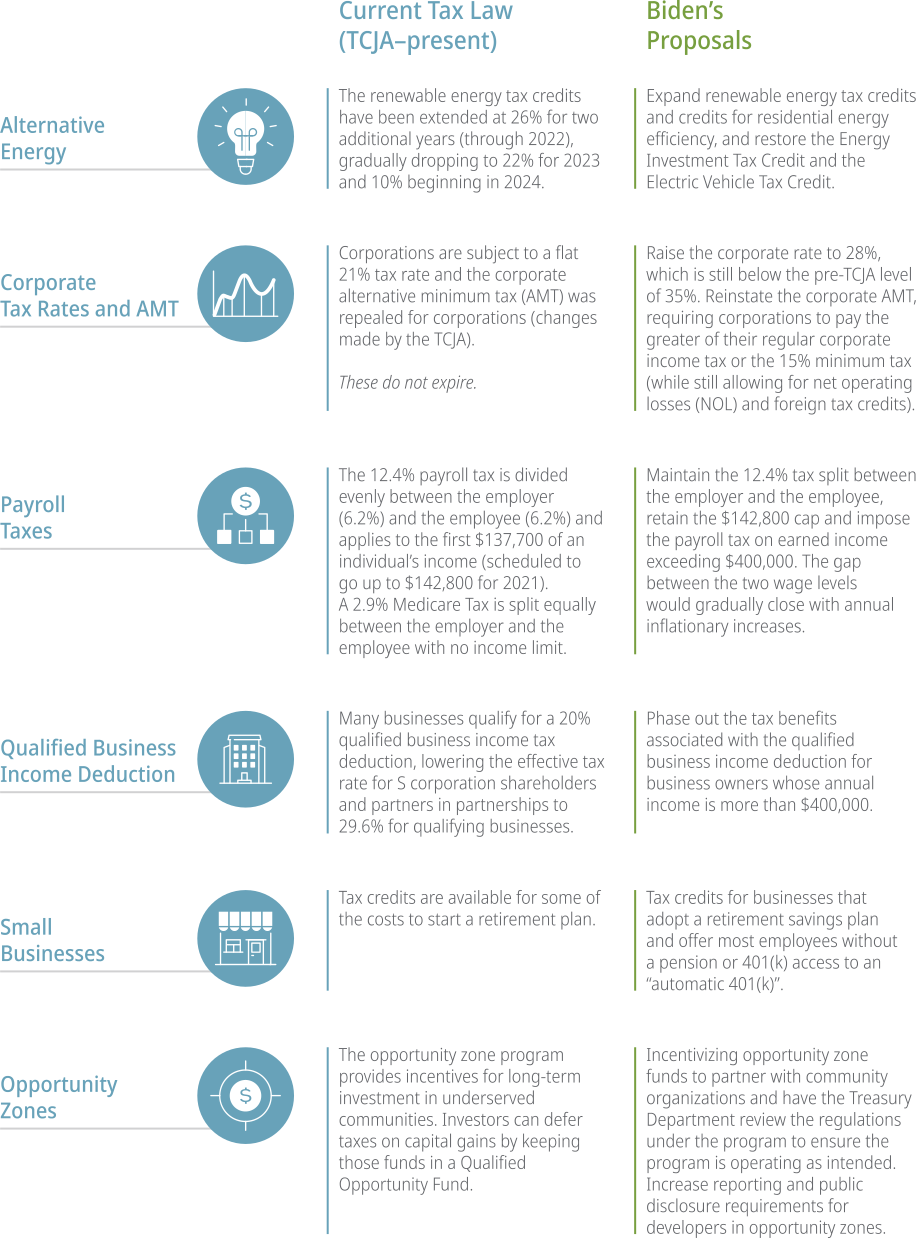
Those will be the bills to watch for any early tax changes, including cuts or credits, that businesses may be able to take advantage of. Larger scale tax changes, particularly any tax increases, may not go into effect until 2022 at the earliest. Here are some of the current rules and how Biden is proposing to deal with them.
If you have questions about your particular situation, please contact our team. We’re here to help.