Skip to Main Content

insightsarticles

State of the industry: BerryDunn's business valuation quarterly report for 2Q 2024

By: Seth Webber,

Lexi Dysinger, CVA is a Senior Valuation Analyst in BerryDunn’s Valuation Services Practice Group. She provides analysis for valuations for gifting, estate planning, ESOPs, transaction support, and other purposes. She holds a Bachelor of Business Administration in Finance from Stetson University.

Lexi Dysinger
09.05.24 /

As we look ahead to fall, here’s a glimpse of what summer was like:

Summer is when the valuation team prepares for the busy times ahead. While our work never truly slows down, we take this opportunity to help ensure we’re well prepared during the busy times. Our summer was full of initiatives like training analysts, getting acquainted with future talent through our intern program, refining templates, and exploring new ways to help our clients create, grow, and protect value. We also spent a little more time digesting economic trends and forecasts and considering what implications these variables may have on business value.

Although summertime is a generally slower time for the valuation team, we’ve seen a notable increase in M&A activity. Transactional activity often follows interest rate trends. We’ve seen activity pick up significantly in the last nine months under the current stable interest rate environment. As rates drop, more deals are sure to follow.

Regarding estate planning, transferring a valuable business interest may become significantly more expensive in 2026. Federal gift and estate tax lifetime exemption amounts are at all-time highs; currently, $13.6 million per individual in 2024. Individuals should be aware of the scheduled sunset of the above-referenced amounts in 2025 with reversion back to previous levels of $5.0 million (adjusted for inflation). Further reading on this topic can be found here.

In our ESOP sector, we continue to perform annual valuations to assist employee-owned companies with share repurchases upon employee retirement. Not all of our ESOP clients have a calendar-year valuation date, so we start to see some of that activity pick up in the third quarter.

Another area where we remain busy is exit planning for business owners. Our goal is to engage with business owners at least five years prior to an exit so there is still time to make course corrections. If business owners delay the process of preparing for a transition, their odds of a successful transition diminish dramatically.

We track trends in several databases of private company transactions, among them GF Data, Capital IQ, DealStats, and BIZCOMPS. As presented below, we saw a slight uptick in multiples in the second quarter of 2024.
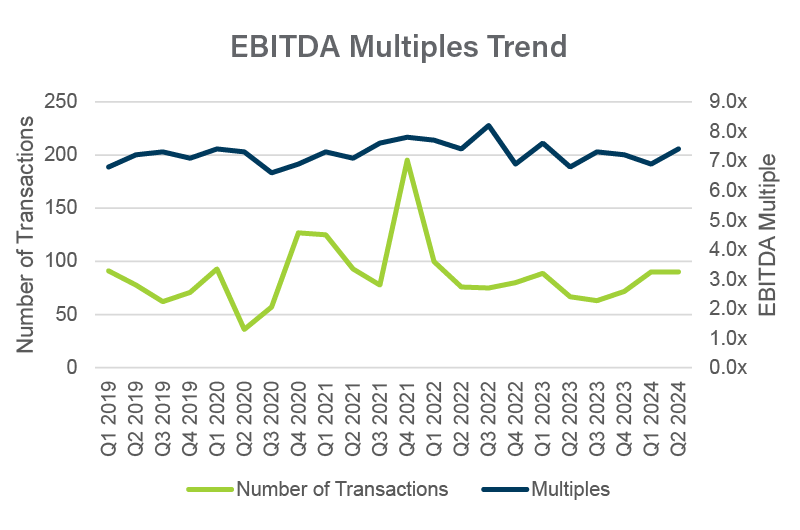
Don’t get too fixated on the multiples in this chart as an indicator of value for your company. Look at the trends. Multiples vary dramatically from industry to industry and business to business. If you are interested in exploring value drivers for your company, read this recent article.  

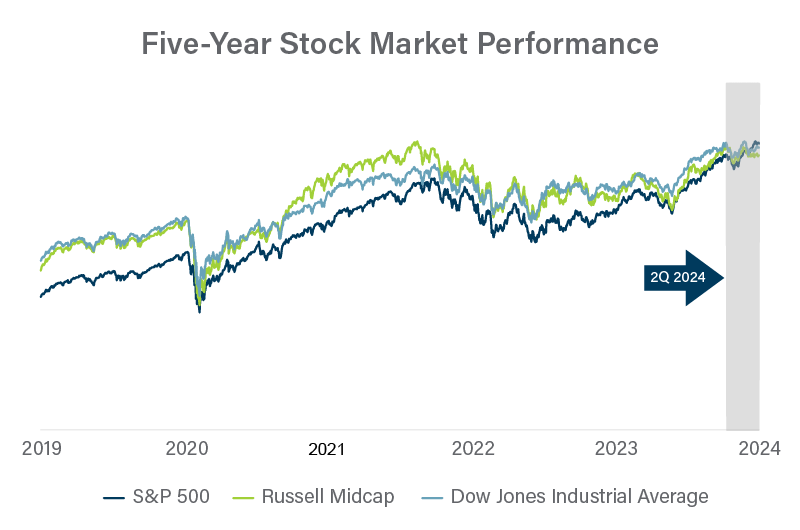
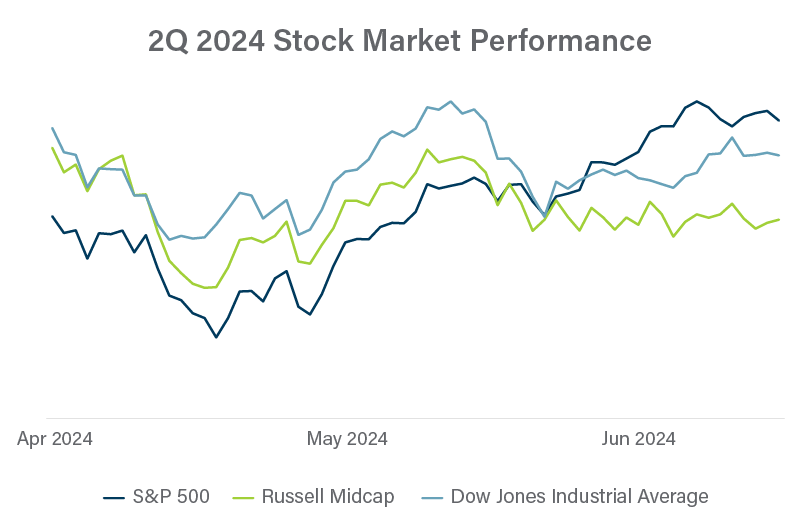
The value of privately held companies typically isn’t as volatile as share prices for public companies. However, activity in the stock market provides general guidance that is often much timelier than data available for private companies.  

There are a few indexes we keep an eye on. Although the S&P 500 is dominated by a handful of large tech stocks, it is generally considered the go-to benchmark for stock market performance. The Russell Midcap Index cuts out the largest 200 companies in the Russell 1000 Index, keeping 800 US companies with market capitalizations between $2 billion and $10 billion. The Dow Jones Industrial Average is comprised of 30 “blue chip” US stocks that may be similar to many private companies.  

Stock prices have followed a generally upward trend throughout the first and second quarters of 2024.
Many drivers of business value can be influenced or controlled by the decisions of the business’s management team, including product diversification, brand recognition, and employee retention. Other drivers are outside of management’s control, such as inflation and unemployment rates. According to Federal Reserve Economic Data, key drivers of the US economy generally remained near similar levels in 2Q as in 1Q.
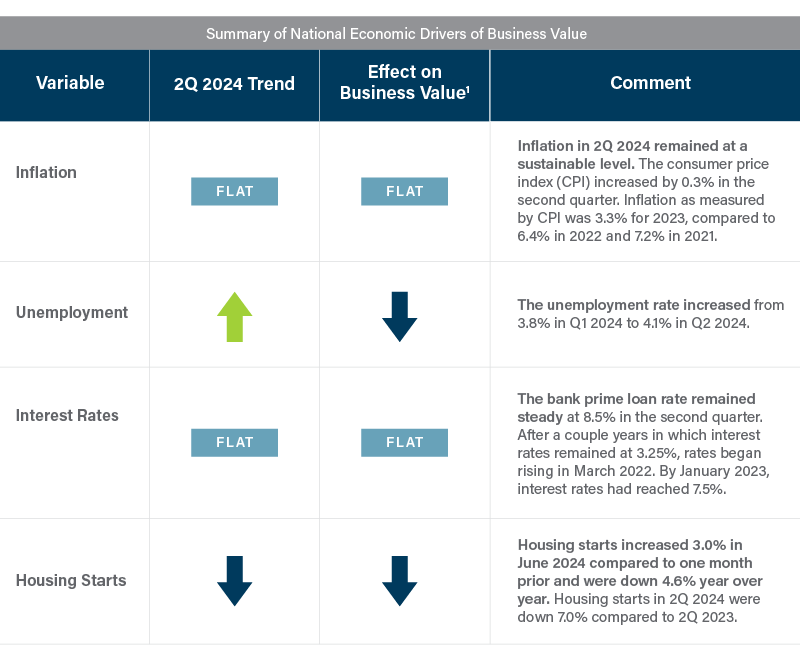
1 Indicates the likely effect on business value for most businesses. Depending on the business model, certain businesses may demonstrate an inverse relationship to economic variables compared to the market as a whole.

As many of our clients are located in New England, we’ve included a summary below of some of the key economic drivers that affect businesses in the Northeast, as quoted from the Beige Book - July 2024. If your business is headquartered outside of New England, reach out to us for an economic analysis specific to your market area. 

Economic activity  

Business activity expanded at a modest pace in recent weeks. Employment was flat amid slow wage growth, and prices increased slightly. Tourism activity rose moderately, while retail sales edged up but generally remained subdued. Sales of new automobiles rose, manufacturers reported modest revenue growth, on average, and software and IT services firms saw moderate revenue gains. Residential home sales increased on a year-over-year basis, supported in part by improvements in inventory levels. Overall commercial real estate activity was flat, on balance, with stable industrial leasing, steady increases in the retail sector, and seasonably slow office activity. However, the outlook for office properties weakened further as contacts expect rising foreclosures. On balance, the economic outlook was cautiously optimistic, but selected contacts expressed greater uncertainty related to the demand later this year being potentially restrained by the upcoming election.

Labor markets  

Employment was unchanged overall, and wages increased at a slight pace. Labor demand held steady with several retail and tourism contacts noting improvements in the available labor supply. In particular, Cape Cod contacts noted normal levels of availability of foreign-born workers through short-term visa programs, which support the seasonal labor demand in the area. Hotel contacts around Boston also reported a normalization of the labor supply across the city and noted that they were finally adequately staffed. Automotive mechanics—across all skill levels—remain in short supply in New Hampshire, but the shortage is most acute for collision repair workers. Headcounts were steady among manufacturers. On balance, manufacturers reported little change in their ability to find qualified workers during the second quarter, but several noted that hiring remains more difficult than before the pandemic. Average manufacturing wages rose slightly, with a small number of firms noting continued wage pressures. A software and IT services contact and a manufacturing contact each noted that they plan to boost hiring in the near term, but in general, hiring plans remain muted across sectors, and new hires are primarily used to replace attrition.

Prices 

Prices increased at a slight pace, on average, and movements in input costs were mixed. Most manufacturing contacts noted either small increases, or no change, in both input costs and finished prices; in contrast, one seafood manufacturer reported modest declines in both. Input costs at an online retailer have remained stable despite pressures in some shipping lanes. Hotel room rates in the Greater Boston area have risen moderately year-over-year, but hospitality contacts on Cape Cod reported average nightly room rates for the season to be flat compared with last year. Prices for software and IT services increased slightly, on balance, during the second quarter, but one contact noted a marked slowing of input cost increases. Office and industrial rent prices were flat with slight increases in retail rents. Residential homes prices across the First District2 rose moderately despite some improvement in inventory levels.

2 The Federal Reserve System’s First District includes Connecticut (excluding Fairfield County), Massachusetts, Maine, New Hampshire, Rhode Island, and Vermont.

Retail and tourism 

First District retail contacts reported slight growth in recent months, on balance, while tourism contacts saw moderate growth, net of seasonal factors. An online retailer noted an intensifying pressure to offer discounts on lower-cost items but also saw an uptick in sales for their higher-end products. Automotive dealers in New Hampshire experienced increased sales of new vehicles in recent months and continued strength in the recreational and power-sports segments of the market (that is, RVs and ATVs). Mainstreet retailers on Cape Cod have had a slightly above average start to the season with fewer store vacancies than in recent years. Airline passenger traffic through Boston increased moderately year-over-year, with significant gains from Caribbean and European travel. Hotel occupancy in greater Boston rose notably, boosted importantly by the NBA finals and several large conventions. Tourism and convention activity for Boston in 2024 is expected to grow, and Cape Cod contacts anticipate a seasonably strong summer. On balance, retailers were cautiously optimistic.

Manufacturing and related services 

Manufacturing revenues rose modestly through the second quarter. All firms contacted noted slight increases in demand, though one reported sales falling short of high expectations. Average input costs and sale prices remained flat in recent months, but results were mixed across firms. Wages rose slightly, with two firms pointing to significant wage pressure. On balance, headcounts remained level with no recent employment growth. A contact discussed ongoing efforts to recruit workers in anticipation of a new facility opening in the immediate future. One contact noted the role of limited housing supply restricting the ability to increase headcount as desired. Most firms reported unchanged plans for capital spending, but some pointed to new investments, including expanded facilities and clean energy solutions. Most contacts report optimistic outlooks with rising sales throughout the remainder of 2024.

IT and software services 

First District contacts in software and IT services reported, on balance, stable demand and continued moderate revenue growth in recent months. Two contacts noted small price increases for their products and services. One contact noted that the significant input cost increases they had experienced over the past two years are moderating, and another contact expects cost savings from transitioning to third-party cloud servers. Headcounts and wages remained unchanged across contacts. Contacts had mixed outlooks but generally predicted steady demand. Concerns included pressure from their customers to focus on AI integration strategies and uncertainty surrounding the upcoming elections restraining some customer decisions. Despite those concerns, contacts overall expressed optimism surrounding continued moderate demand and waning inflationary pressures.

Commercial real estate 

First District contacts described commercial real estate activity as flat overall. Office leasing slowed somewhat, as is typical for summer, but fell to an extremely low level in Hartford, CT. Office rents were flat, and office vacancy rates increased slightly. After having softened earlier in the year, industrial leasing was stable. Industrial vacancy rates remained extremely low, and industrial rents have reportedly stabilized at levels well above 2019 averages. The retail sector experienced steady demand, but tenants showed greater caution amid worries about consumer spending. Investment sales were flat, even though demand for non-office properties remained healthy. In general, bank lending to commercial real estate remained weak, but the CMBS market and life insurance companies continued to provide funding. However, one small regional bank expanded its (non-office) CRE portfolio modestly. Construction was flat or down slightly and still concentrated in the multifamily sector. For non-office properties, contacts expected stable, if restrained, activity going forward, reflecting elevated political and economic uncertainty. The outlook for office properties weakened further, as contacts expected a significant increase in foreclosures in the coming 12 months.

Residential real estate 

Contacts in housing markets across the First District reported annual growth in inventory. Rhode Island, Maine, Vermont, and New Hampshire all reported significant increases in the number of single-family homes and condos on the market in May. In contrast, inventory levels in Massachusetts were comparable to those from a year ago. These inventory changes were accompanied by moderate annual growth in both prices and in the number of closed sales. Contacts noted that despite these improvements, the inventory levels remain short of a balanced market. The resulting imbalance leaves some buyers in the position of having to compete for desired properties, but others noted that the upward trends could produce a more favorable environment for buyers in the months ahead.

Where to find us

  • Casey Karlsen and Seth Webber will be leading a four-part workshop series for business owners about increasing business value and liquidity beginning on October 8.
  • Lexi Dysinger, Meridith Byrne, and Seth Webber will be attending the New England Chapter of The ESOP Association’s Fall Conference in Springfield, Massachusetts on October 15 and October 16.
  • Casey Karlsen will be presenting a session titled “Exit Planning and Value Acceleration” at the Maine Tax Forum on November 7.
  • Erik Olson, Seth Webber, and Casey Karlsen will be hosting a transaction advisory overview session on January 15.

Interested in meeting the team? Please reach out to us. We would love to connect. 

Related Industries

Related Services

Related Professionals

Leaders

BerryDunn experts and consultants

Lexi Dysinger, CVA is a Senior Valuation Analyst in BerryDunn’s Valuation Services Practice Group. She provides analysis for valuations for gifting, estate planning, ESOPs, transaction support, and other purposes. She holds a Bachelor of Business Administration in Finance from Stetson University.

Professional
Lexi Dysinger

What are the top three areas of improvement right now for your business? In this third article of our series, we will focus on how to increase business value by aligning values, decreasing risk, and improving what we call the “four C’s”: human capital, structural capital, social capital, and consumer capital.

To back up for a minute, value acceleration is the process of helping clients increase the value of their business and build liquidity into their lives. Previously, we looked at the Discover stage, in which business owners take inventory of their personal, financial, and business goals and assemble information into a prioritized action plan. Here, we are going to focus on the Prepare stage of the value acceleration process.

Aligning values may sound like an abstract concept, but it has a real world impact on business performance and profitability. For example, if a business has multiple owners with different future plans, the company can be pulled in two competing directions. Another example of poor alignment would be if a shareholder’s business plans (such as expanding the asset base to drive revenue) compete with personal plans (such as pulling money out of the business to fund retirement). Friction creates problems. The first step in the Prepare stage is therefore to reduce friction by aligning values.

Reducing risk

Personal risk creates business risk, and business risk creates personal risk. For example, if a business owner suddenly needs cash to fund unexpected medical bills, planned business expansion may be delayed to provide liquidity to the owner. If a key employee unexpectedly quits, the business owner may have to carve time away from their personal life to juggle new responsibilities. 

Business owners should therefore seek to reduce risk in their personal lives, (e.g., life insurance, use of wills, time management planning) and in their business, (e.g., employee contracts, customer contracts, supplier and customer diversification).

Intangible value and the four C's

Now more than ever, the value of a business is driven by intangible value rather than tangible asset value. One study found that intangible asset value made up 87% of S&P 500 market value in 2015 (up from 17% in 1975). Therefore, we look at how to increase business value by increasing intangible asset value and, specifically, the four C’s of intangible asset value: human capital, structural capital, social capital, and consumer capital. 

Here are two ways you can increase intangible asset value. First of all, do a cost-benefit analysis before implementing any strategies to boost intangible asset value. Second, to avoid employee burnout, break planned improvements into 90-day increments with specific targets.

At BerryDunn, we often diagram company performance on the underlying drivers of the 4 C’s (below). We use this tool to identify and assess the areas for greatest potential improvements:

By aligning values, decreasing risk, and improving the four C’s, business owners can achieve a spike in cash flow and business value, and obtain liquidity to fund their plans outside of their business.

If you are interested in learning more about value acceleration, please contact the business valuation services team. We would be happy to meet with you, answer any questions you may have, and provide you with information on upcoming value acceleration presentations.

Article
The four C's: Value acceleration series part three (of five)

This is our second of five articles addressing the many aspects of business valuation. In the first article, we presented an overview of the three stages of the value acceleration process (Discover, Prepare, and Decide). In this article we are going to look more closely at the Discover stage of the process.

In the Discover stage, business owners take inventory of their personal, financial, and business goals, noting ways to increase alignment and reduce risk. The objective of the Discover stage is to gather data and assemble information into a prioritized action plan, using the following general framework.

Every client we have talked to so far has plans and priorities outside of their business. Accordingly, the first topic in the Discover stage is to explore your personal plans and how they may affect business goals and operations. What do you want to do next in your personal life? How will you get it done?

Another area to explore is your personal financial plan, and how this interacts with your personal goals and business plans. What do you currently have? How much do you need to fund your other goals?

The third leg of the value acceleration “three-legged stool” is business goals. How much can the business contribute to your other goals? How much do you need from your business? What are the strengths and weaknesses of your business? How do these compare to other businesses? How can business value be enhanced? A business valuation can help you to answer these questions.

A business valuation can clarify the standing of your business regarding the qualities buyers find attractive. Relevant business attractiveness factors include the following:

  • Market factors, such as barriers to entry, competitive advantages, market leadership, economic prosperity, and market growth
  • Forecast factors, such as potential profit and revenue growth, revenue stream predictability, and whether or not revenue comes from recurring sources
  • Business factors, such as years of operation, management strength, customer loyalty, branding, customer database, intellectual property/technology, staff contracts, location, business owner reliance, marketing systems, and business systems

Your company’s performance in these areas may lead to a gap between what your business is worth and what it could be worth. Armed with the information from this assessment, you can prepare a plan to address this “value gap” and look toward your plans for the future.

If you are interested in learning more about value acceleration, please contact the business valuation services team. We would be happy to meet with you, answer any questions you may have, and provide you with information on upcoming value acceleration presentations.

Next up in our value acceleration series is all about what we call the four C's of the value acceleration process. 

Article
The discover stage: Value acceleration series part two (of five)

This is the first article in our five-article series that reviews the art and science of business valuation. The series is based on an in-person program we offer from time to time.  

Did you know that just 12 months after selling, three out of four business owners surveyed “profoundly regretted” their decision? Situations like these highlight the importance of the value acceleration process, which focuses on increasing value and aligning business, personal, and financial goals. Through this process, business owners will be better prepared for business transitions, and therefore be significantly more satisfied with their decisions.

Here is a high-level overview of the value acceleration process. This process has three stages, diagrammed here:

The Discover stage is also called the “triggering event.” This is where business owners take inventory of their situation, focusing on risk reduction and alignment of their business, personal, and financial goals. The information gleaned in this stage is then compiled into a prioritized action plan utilized in future stages.

In the Prepare stage, business owners follow through on business improvement and personal/financial planning action items formed in the discover stage. Examples of action items include the following:

  • Addressing weaknesses identified in the Discover stage, in the business, or in personal financial planning
  • Protecting value through planning documents and making sure appropriate insurance is in place
  • Analyzing and prioritizing projects to improve the value of the business, as identified in Discover stage
  • Developing strategies to increase liquidity and retirement savings

The last stage in the process is the Decide stage. At this point, business owners choose between continuing to drive additional value into the business or to sell it.

Through the value acceleration process, we help business owners build value into their businesses and liquidity into their lives.

If you are interested in learning more about value acceleration, please contact the business valuation services team. We would be happy to meet with you, answer any questions you may have, and provide you with information on upcoming value acceleration presentations.

Read more! In our next installment of the value acceleration blog series, we cover the Discover stage.

Article
The process: Value acceleration series part one (of five)

Executive compensation, bonuses, and other cost structure items, such as rent, are often contentious issues in business valuations, as business valuations are often valued by reference to the income they produce. If the business being valued pays its employees an above-market rate, for example, its income will be depressed. Accordingly, if no adjustments are made, the value of the business will also be diminished.

When valuing controlling ownership interests, valuation analysts often restate above- or below-market items (compensation, bonuses, rent, etc.) to a fair market level to reflect what a hypothetical buyer would pay. In the valuation of companies with ESOPs, the issue gets more complicated. The following hypothetical example illustrates why.

Glamorous Grocery is a company that is 100% owned by an ESOP. A valuation analyst is retained to estimate the fair market value of each ESOP share. Glamorous Grocery generates very little income, in part because several executives are overcompensated. The valuation analyst normalizes executive compensation to a market level. This increases Glamorous Grocery’s income, and by extension the fair market value of Glamorous Grocery, ultimately resulting in a higher ESOP share value.

Glamorous Grocery’s trustee then uses this valuation to establish the market price of ESOP shares for the following year. When employees retire, Glamorous Grocery buys employees out at the established share price. The problem? As mentioned before, Glamorous Grocery generates very little income and as a result has difficulty obtaining the liquidity to buy out employees.

This simple example illustrates the concerns about normalizing executive compensation in ESOP valuations. If you reduce executive compensation for valuation purposes, the share price increases, putting a heavier burden on the company when you redeem shares. The company, which already has reduced income from paying above-market executive compensation, may struggle to redeem shares at the established price.

While control-level adjustments may be common, it is worth considering whether they are appropriate in an ESOP valuation. It is important that the benefit stream reflect the underlying economic reality of the company to ensure longevity of the company and the company’s ESOP.

Questions? Our valuation team will be happy to help. 

BerryDunn’s Business Valuation Group partners with clients to bring clarity to the complexities of business valuation, while adhering to strict development and reporting standards. We render an independent, objective opinion of your company’s value in a reporting format tailored to meet your needs. We thoroughly analyze the financial and operational performance of your company to understand the story behind the numbers. We assess current and forecasted market conditions as they impact present and future cash flows, which in turn drives value.

Article
Compensation, bonuses, and other factors that can make or break an Employee Stock Ownership Plan (ESOP)

So far in our value acceleration article series, we have talked about increasing the value of your business and building liquidity into your life starting with taking inventory of where you are at and aligning values, reducing risk, and increasing intangible value.

In this article, we are going to focus on planning and execution. How these action items are introduced and executed may be just as important as the action items themselves. We still need to protect value before we can help it grow. Let’s say you had a plan, a good plan, to sell your business and start a new one. Maybe a bed-and-breakfast on the coast? You’ve earmarked the 70% in cash proceeds to bolster your retirement accounts. The remaining 30% was designed to generate cash for the down payment on the bed-and-breakfast. And it is stuck in escrow or, worse yet, tied to an earn-out. Now, the waiting begins. When do you get to move on to the next phase? After all that hard work in the value acceleration process, you still didn’t get where you wanted to go. What went wrong?

Many business owners stumble at the end because they lack a master plan that incorporates their business action items and personal action items. Planning and execution in the value acceleration process was the focus of our conversation with a group of business owners and advisors on Thursday, April 11th.

Business valuation master plan steps to take

A master plan should include both business actions and personal actions. We uncovered a number of points that resonated with business owners in the room. Almost every business owner has some sort of action item related to employees, whether it’s hiring new employees, advancing employees into new roles, or helping employees succeed in their current roles. A review of financial practices may also benefit many businesses. For example, by revisiting variable vs. fixed costs, companies may improve their bidding process and enhance profitability. 

Master plan business improvement action items:

  • Customer diversification and contract implementation
  • Inventory management
  • Use of relevant metrics and dashboards
  • Financial history and projections
  • Systems and process refinement

A comprehensive master plan should also include personal action items. Personal goals and objectives play a huge role in the actions taken by a business. As with the hypothetical bed-and-breakfast example, personal goals may influence your exit options and the selected deal structure. 

Master plan personal action items:

  •  Family involvement in the business
  •  Needs vs. wants
  •  Development of an advisory team
  •  Life after planning

A master plan incorporates all of the previously identified action items into an implementation timeline. Each master plan is different and reflects the underlying realities of the specific business. However, a practical framework to use as guidance is presented below.

The value acceleration process requires critical thinking and hard work. Just as important as identifying action items is creating a process to execute them effectively. Through proper planning and execution, we help our clients not only become wealthier but to use their wealth to better their lives. 

If you are interested in learning more about value acceleration, please contact the business valuation services team. We would be happy to meet with you, answer any questions you may have, and provide you with information on upcoming value acceleration presentations. 

Article
Planning and execution: Value acceleration series part four (of five)

Consider the implications of the following statistics:

While a massive number of people are retiring each year and counting on the value of their business as part of their retirement plan, many are unable to actually generate any liquidity beyond normal compensation. They may even have a very valuable business, but can’t convert any of that value into cash. What a terrible situation! They may feel like a sailor stranded on a desert island—surrounded by water, but dying of thirst.

Attaining liquidity from your business and increasing business value are two topics that go hand in hand. Factors that increase business value often also increase the ease of selling the business. Even if your plan is to never sell, increasing profitability and liquidity will make planning easier. In this blog post, we will identify five ways business owners can improve business value and increase the likelihood of selling the business at a desirable price.

Businesses are often valued by using an income metric (such as earnings before interest, taxes, depreciation, and amortization, or EBITDA) and a valuation pricing multiple.


To increase business value, business owners can increase the valuation pricing multiple, increase income, or both. Focusing on improving the multiple is often a more effective way to increase business value.

Business risk is the key driver of the multiple. Five effective ways to improve the multiple are:

  1. Reduce reliance on the owner of the business
  2. Incentivize key employees to sign long-term employment contracts
  3. Diversify the customer base
  4. Create sustainable recurring revenue 
  5. Maintain immaculate financial statements

By planning ahead and implementing the above steps, business owners may be in a much better position for retirement.

P.S. We host a regular value acceleration presentation series. Please contact me or visit our event calendar to learn more. We would love to have you attend. These presentations focus on the process to increase the value of your business and build liquidity into your life.

Article
Value acceleration—The gas pedal for the value of your business